
Roof insurance guide
Roof Insurance Claims: What Is Covered and How They Are Paid
Insurance usually pays for what a storm does to a roof, not for what age does to it. Here is what a claim covers, how the money arrives, and when a small repair is better paid for yourself.
Monday to Saturday, from first thing in the morning until six in the evening. Calls outside those hours go to voicemail and we return them the next working morning.
Inspect Before You File
One call sets a free roof inspection, and we photograph and write up the damage before your claim goes in.
(208) 858-8078 Call for a Free Estimate- Free and no-obligation
- Same-day callback
What a policy pays for
What Insurance Covers on a Roof
Homeowners insurance can usually cover sudden damage from a storm, hail or wind, but not the normal wear and tear of a roof getting older.
A claim turns on one question: did something happen to the roof, or did the roof simply age? A shingle a gust folded last week is storm damage. Shingles worn bald over many summers are age.
Some signs sit on both sides of that line. "Granule loss", the grit you find in the gutters, comes from aging and from hail alike, which is why the roof is looked at up close and photographed before anyone calls it one or the other.
Usually covered
Damage that arrives all at once, in a storm:
- Hail that bruises the shingles and knocks the granules loose.
- Wind that lifts, tears off or folds a shingle. A "creased shingle" has a broken mat and no longer seals.
- Storm damage you can tie to the day it happened.
Usually not covered
Wear that builds up over the years:
- Normal wear and tear on a roof that has simply reached its age.
- Shingles gone bald from years of sun rather than one storm.
- A cracked "pipe boot", the rubber collar around a vent pipe, which splits with age and sun.
Step by step
How a Roof Claim Works
The roof is inspected and the damage documented before the claim is filed, and all the way through we document and advocate for you, while the insurance adjuster, not the roofer, adjusts the claim.
Where we stand in a claim
We are roofers, not insurance adjusters. We find the damage, photograph it, write it up and speak up for you through the claim; your insurer decides what the policy pays.
storm damage roof repairA storm claim on a roof runs in these five steps:
Call us before you file
We set a time to walk the roof. The estimate is free and carries no obligation, whether or not you end up filing.
We inspect and document
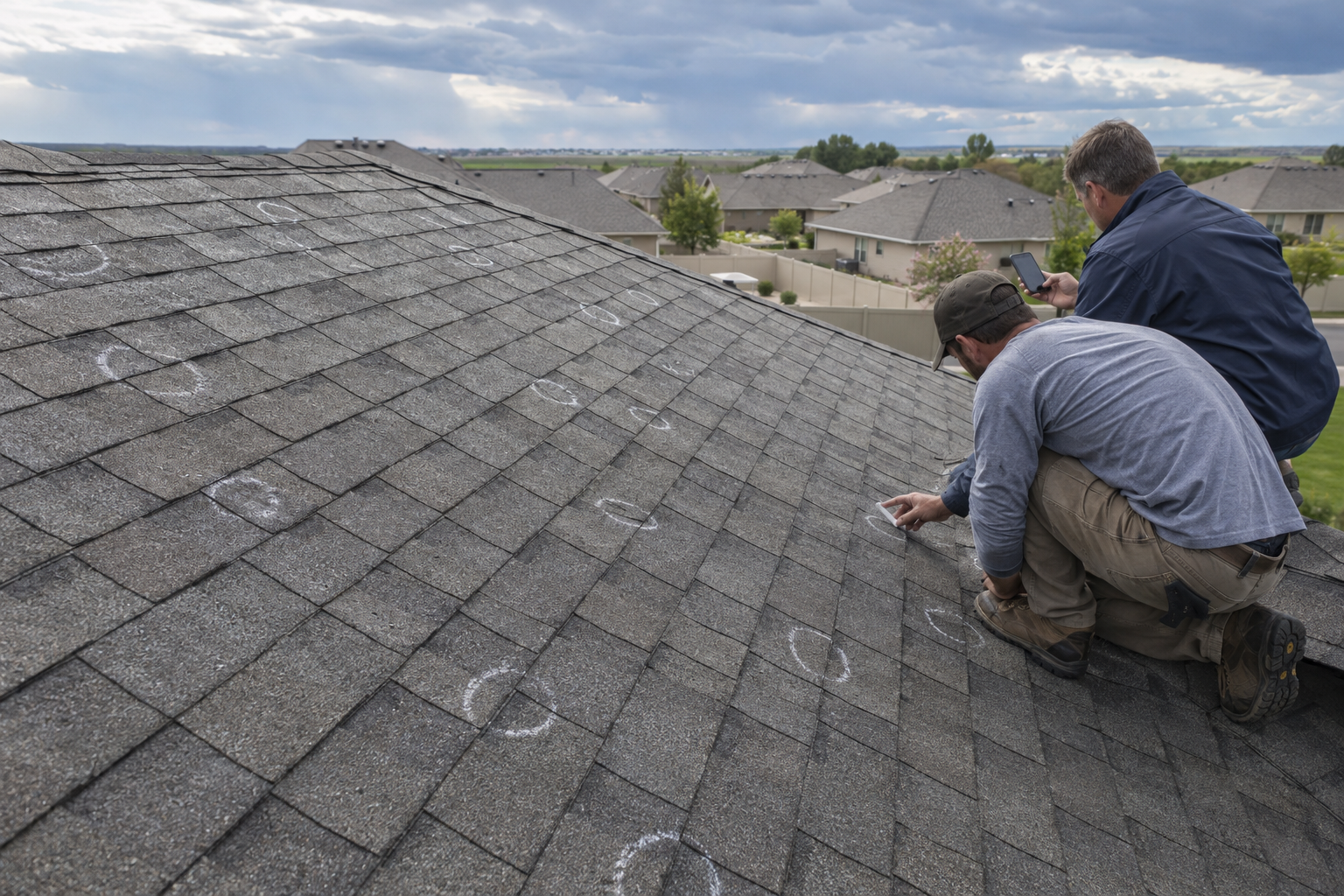
We walk every slope, circle hail hits in chalk and photograph creased and missing shingles, so the damage is on record before the claim goes in.
You file the claim
You open the claim with your insurance company, with our photos and written findings in hand.
The adjuster inspects
Your insurer's adjuster looks at the roof and writes the estimate the payment is based on. Most insurers price it in "Xactimate", the same estimating software roofers price claims in.
Missed items go back in
If the insurer's estimate left out damage we documented, it goes back as a "supplemental claim". Then the work is scheduled.
How the money arrives
How a Roof Claim Is Paid
On a replacement-cost policy, the insurer may pay the depreciated amount first and the rest after the work is done and documented.
Paid first
The depreciated amount
What the damaged roof was worth at its age, worn as it was on the day of the storm.
In between
The work, done and documented
The new roof goes on, and the finished work is put on record for the insurer.
Paid after
The rest of the claim
The depreciation that was held back, released once the insurer has that record.
Depreciation is what a roof's age takes off its value. A "replacement cost (RCV)" policy holds that amount back instead of keeping it, which is why the first check can look short. An "actual cash value" policy deducts depreciation, so before you plan a new roof around a claim, find out which kind you carry.
If a payment or a decision does not make sense to you, the Idaho Department of Insurance, the state agency that regulates homeowners insurance, answers consumer questions about claims.
Building code
Code Upgrades and Ordinance and Law Coverage
A standard homeowners policy does not pay the extra cost of meeting current building codes unless it carries "Ordinance and Law" coverage.
When an old roof comes off, the new one is built to the code in force today, not the code in force when the house went up, and the difference can show up on the estimate as items the old roof never had.
Whether your policy carries it is a line worth finding before a storm, not after one, and your agent can tell you in a single call.
Ask your agent these three questions before you file.
- Is my policy replacement cost or actual cash value?
- Do I carry Ordinance and Law coverage?
- What is my deductible on a roof claim?
We can tell you what the roof needs. Your agent can tell you what the policy pays.
When to Skip a Claim
If only a few shingles are damaged, paying for the repair yourself may make more sense than filing a claim.
A handful of creased or missing shingles is a small repair, and a claim brings its own paperwork and an adjuster's visit. Call us first: we tell you what we found and quote the repair in writing, and you decide whether the claim is worth it.
roof repairFree and no-obligation, quoted in writing.
From a neighbor
Michael did a great job for us. Met him randomly because he bought something from me on FB Marketplace, and then we got talking. Soon enough we were walking around on my roof and he gave me a very competitive quote. He was super professional and the roof is done right. I feel lucky to have found him!
After the storm
Have the roof looked at before you file
Call and we will walk the roof, photograph what the storm did and write it up, so your claim starts from a record instead of a guess. The estimate is free and carries no obligation.
Monday to Saturday, from first thing in the morning until six in the evening. Calls outside those hours go to voicemail and we return them the next working morning.