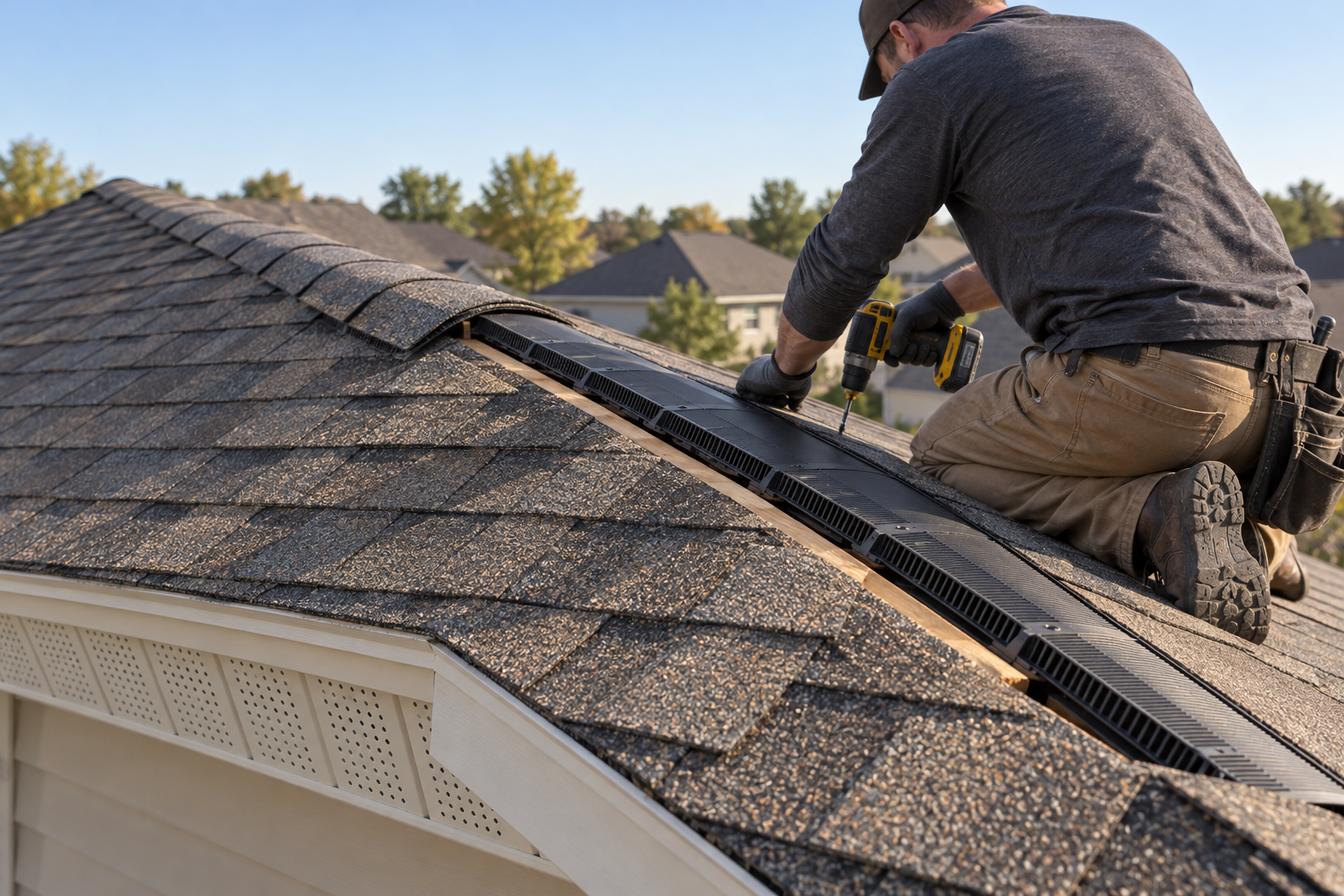
Roofer fastening a ridge vent along the peak of an asphalt shingle roof, soffit vents under the eave below

Attic intake and exhaust

Roof Ventilation: How Intake and Exhaust Protect the Shingles

Air comes in low at the soffits and leaves high at the ridge, and that steady flow is what keeps attic heat from aging your shingles from underneath. Here is how both halves work together, and when fixing them costs the least.

Monday to Saturday, from first thing in the morning until six in the evening. Calls outside those hours go to voicemail and we return them the next working morning.

Is Your Attic Breathing?

One call sets a time to look at your soffits, your ridge and the attic between them, and tell you plainly whether both halves match.

(208) 858-8078 Call for a Free Estimate
  • Licensed and insured
  • No surprise charges

The short answer

What Roof Ventilation Does

Roof ventilation is a steady flow of outside air that comes in at the soffits, under the eaves, and goes out at the ridge, carrying the attic's heat and moisture out with it.

It works as a pair. The "intake" is the low half and the "exhaust" is the high half, and warm air rising through the attic is what pulls fresh air in behind it. Leave either half out and the air in the attic sits still.

On a vented shingle roof the air takes the same three-stop path:

  1. In at the soffits. Outside air enters through vents in the underside of the eaves.
  2. Up through the attic. It rises under the roof deck and picks up the heat and moisture.
  3. Out at the ridge. It leaves through the vent that runs along the peak of the roof.

Ventilation is one of the roof requirements the International Residential Code chapter on roof assemblies sets out, alongside underlayment, ice barriers and flashing.

How the air moves

Both eaves feed the ridge: intake low on each side, exhaust high in the middle.

Intake and Exhaust Vents

Soffit vents bring the air in, a ridge vent and attic fans let it out, and a ridge vent only works when there is soffit intake below it.

Each of these has its own place on the roof and its own job to do:

  • Intake

    Soffit vents

    Openings in the underside of the eaves that let outside air into the attic down low. They are the half every exhaust vent draws from.

  • Exhaust

    Ridge vent

    A low vent run along the peak of the roof, under the "ridge caps", where the warm air leaves. Without soffit intake under it, it has nothing to pull.

  • Exhaust

    Attic fans

    Fans, solar attic fans among them, are added to pull more air out and improve attic ventilation. They work the exhaust side, so they still need intake to draw from.

Match both halves. We look at intake and exhaust together, so any exhaust we add at the peak has enough open soffit along the eaves to draw from.

Why it matters

What Poor Ventilation Does to Shingles

Heat trapped in a poorly vented attic ages the shingles from underneath and takes years off the roof.

Shingles already take the sun from above. In an attic that cannot breathe they get it from below as well, from heat that has nowhere to go, and the moisture that should leave with the air stays behind under the deck.

Air moving

Outside air comes in at the soffits and carries the heat and moisture out at the ridge, so the underside of the roof is not left to bake.

Air trapped

The heat builds and has nowhere to go, so the deck and the shingles on it bake from below through every hot afternoon.

Not sure which one your attic is? We look at the intake and the exhaust when we come out for a free estimate.

Call for a Free Estimate

Timing

Fixing Ventilation During a Reroof

Correcting attic ventilation costs far less as part of a reroof than as a separate project later.

During a replacement the old roof comes off down to the "decking" in a "tear-off", so cutting the ridge slot and opening up the soffits is part of work that is already under way. Done later, the same fix means going back onto a finished roof as a job of its own.

If your roof is getting near replacement, that is the time to ask about the vents.

The better time

With the reroof

The deck is open and the crew is already on the roof, so the vents are corrected as part of the new roof for far less.

Call for a Free Estimate

Free and no-obligation, with the whole job quoted before we start. A full tear-off, the cheapest time to correct the vents, is part of our

roof replacement

As its own project later

The same vents on a finished roof become a separate job, and correcting them that way costs far more than it would have during the reroof.

Ventilation and Shingle Warranties

Shingle warranties rely on the application and ventilation guidance the manufacturers set.

That guidance comes from ARMA, the Asphalt Roofing Manufacturers Association, and installing to the manufacturer's guidelines is what keeps a warranty valid, so how the attic breathes is part of what the warranty rests on. The NRCA Roofing Manual is the industry reference for the roof details around it.

From a neighbor

What a neighbor said about our work

Michael did a great job for us. Met him randomly because he bought something from me on FB Marketplace, and then we got talking. Soon enough we were walking around on my roof and he gave me a very competitive quote. He was super professional and the roof is done right. I feel lucky to have found him!
Matthew NelsonGoogle review

And what we hold to on every roof we look at:

  • Free, no-obligation estimates
  • We show up when we say we will
  • We clean up when the work is done

Intake and exhaust

Want to know how your attic is venting?

Call and we will look at the soffits, the ridge and the attic between them, tell you whether both halves match, and quote any fix before we start.

Monday to Saturday, from first thing in the morning until six in the evening. Calls outside those hours go to voicemail and we return them the next working morning.

Call for a Free Estimate (208) 858-8078

We answer the phone or call back the same working day.

Call (208) 858-8078